
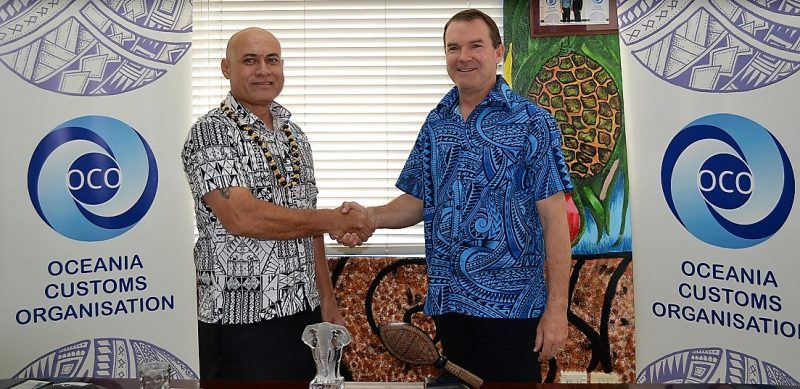
Meeting with Secretary General of the Convention on International Trade in Endangered Species of Wild Fauna and Flora (CITES)
 The OCO Head of Secretariat, Mr Seve Paeniu, met with the Secretary General of the Convention on International Trade in Endangered Species of Wild Fauna and Flora (CITES), Mr John Scanlon, on 30 May 2017 at OCO Headquarters in Suva, Fiji.
Mr Scanlon used the opportunity of being in Fiji for the Oceania Regional CITES Implementation and Prevention of Wildlife Trafficking Workshop from 29 May to 2 June 2017, to meet the OCO.
In discussing areas of potential collaboration between the CITES Secretariat and the OCO, Mr Scanlon affirmed that the work of Customs Agencies throughout the world was central to ensuring compliance with the 1973 Convention, and restricting illegal trade of wild fauna and flora. To facilitate this work, there is an e-CITES module for ASYCUDA that has been developed in conjunction with UNCTAD that will soon be implemented in the Pacific region. This e-CITES module will facilitate issuing of CITES permits and clearances and as well as providing a platform for exchange of information between countries on illicit trade of wild fauna and flora. CITES will also be undertaking some work in the Pacific region to review and strengthen national legislation related to CITES. The formalisation of the collaborative relationship between both organisations through a Memorandum of Understanding, was also discussed and supported.
End.
Reported on the The Fiji Times Online.