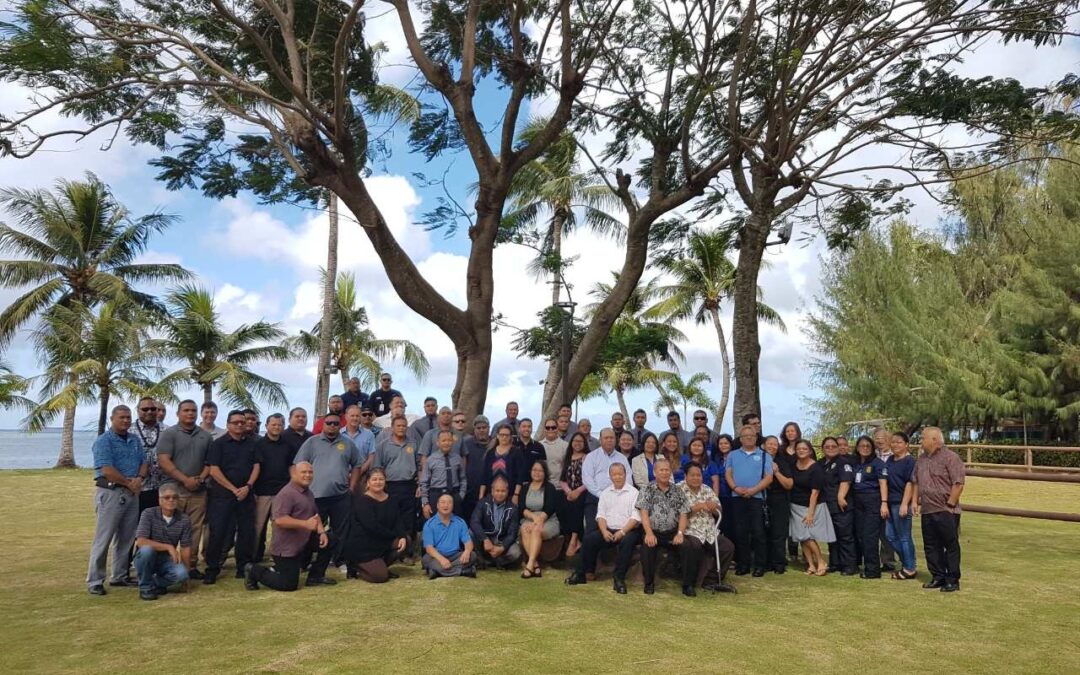
 More than 60 personnel from various law enforcement agencies underwent a five-day National Workshop on Financial Crime. The Training was organized by OCO in collaboration with its key law enforcement partners in CNMI, that ran from the 13th – 17th November 2017.
The training covered a range of Topics which included: illicit financial flows, customs valuation, trade-based money Laundering, money laundering, casino and money-laundering operations, cyber-crime, regional data analysis, informal money transfers systems, risk management, intelligence, legislative platforms and information sharing.
The Training was conducted by Enforcement agencies which included Asia Pacific Group on Money Laundering [APG], New Zealand Customs NZCS, New Zealand Police NZP, Joint interagency Task Force West JITFWEST, US Immigration & Customs Enforcement USICE and Oceania Customs Organisation OCO., The overall aim of the workshop was to ensure that regional efforts are properly coordinated to combat illicit financial flows and transnational organised crime, which has an adverse effect on livelihoods, Social structures, and governance of any economy.
The participants included 32 from the Commonwealth Casino Commission; 17 from the Division of Customs Services; three from the Department of Public Safety; eight from the Division of Revenue and Taxation; and three from Revenue and Taxation-Enforcement. They received their completion certifications during a ceremony led by Gov. Ralph D.L.G. Torres in Seaside Hall at the Kanoa Resort
CNMI Customs Director Joe Mafnas said that one of the objective of the training was to assist the CNMI in developing their financial literacy skills and use the existing tools and network to combat money laundering and other financial crimes,”
OCO is working closely with its key partners in creating awareness on this continuous evolving security Landscape.