
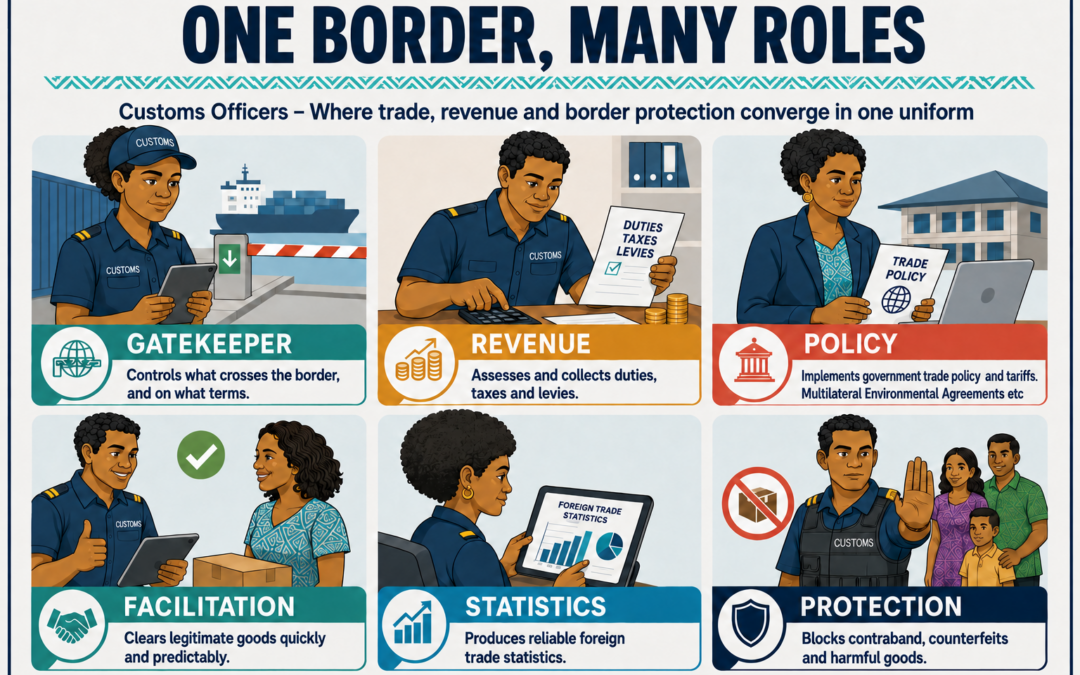
Ask most people what a Customs officer does, and the answer usually comes from personal experience: a passport stamped at the airport, duty charged on a parcel from overseas, or a plant cutting confiscated at the border.
Customs is often seen as a uniform at the airport or wharf.
In the Pacific, however, that uniform represents a far wider responsibility.
Pacific Customs officers facilitate trade, collect revenue, provide trade data and protect communities.
Share This

Priority 1

Customs Leadership

Overall Objective: Enhance the Leadership capability to enable Customs’ modernisation reforms

Develop and strengthen Members’ leadership capabilities at executive management and supervisory levels

* Strengthen the implementation of the current OCO Professional Standards Framework (OPSF).
* Facilitate executive and management programmes with a continued focus on women in leadership
* Develop mentoring and internship programmes and modules
* Develop front line supervision training
* Develop a train the trainer program
* Provide ethics and governance training

Strengthen organisational development for the future

* Conduct annual training needs analysis for individual Members
* Facilitate and promote the use of relevant WCO and OCO E-learning modules
* Develop a Gender Equality Plan for Customs
* Policy and Legislative skill development
* Develop a pathway to be a recognised accredited Customs training provider
* Secretariat and Member engagement at regional and international forums.
* Build and maintain a Customs Expert database

Strengthen succession planning

  • * Development of executive and leadership courses for Member administrations
  • * Conduct a regional workshop on Corporate Governance and Succession Planning for Member administrations