
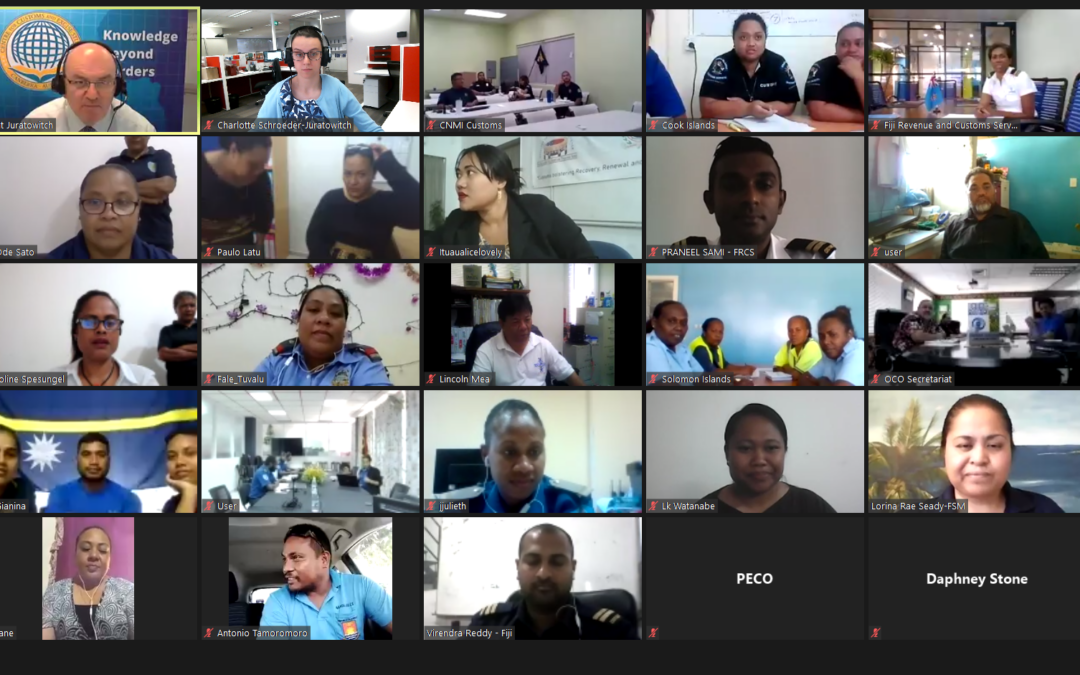
OCO Secretariat and participants discussing with CCES regarding Online Training courses 2020-21
Suva, Fiji, February 24, 2021– More than 80 officers from 17 countries in the region begin a 10-month online training this month aimed at equipping them with skills to address daily challenges and those brought on by the impacts of the COVID-19 pandemic.
The training delivered by the Centre for Customs and Excise Studies, Charles Sturt University, Canberra, and the Oceania Customs Organisation will end in November and leads to a Certificate III in Regional Customs Administrations.
“This is the largest training of its kind, in terms of numbers to be undertaken by OCO in the region,” OCO Chairman and Salvador Jacob said. “It is an important training as we need to have our Customs Officers equipped with skills relevant to the changing environment, we work in. We are especially pleased that more than 60 percent of our trainees are women.”
CCES Chief Executive Officer, Professor David Widdowson said “the Centre is pleased to be working with the OCO to deliver its Professional Standards Framework Program.”
“We fully support the goals of the program to professionalize and improve the proficiency of Customs Officers throughout the Pacific region,” Professor Widdowson said. “In particular, we look forward to assisting the officers who undertake the various courses to build their professional and technical competence; and to support those who become the regional trainers of the future to share and transfer their knowledge at the national and regional level. In this way, the Program will provide the OCO and its member administrations with sustainability and a level of professional development that will set a benchmark for customs regions around the world.”
There will be eight modules of the training covering risk management, ethics and governance, enforcement and compliance, tariff, valuation and legislations.
“COVID-19 has taught us to be more innovative in resolving the challenges we face,” Vanuatu Deputy Director of Customs Operation Jessica Tarivonda said. “This regional training is important as we are able to continue building the capacity of our customs officers. It is important for customs administrations in the region to collaborate and work together for border security as criminal activities have no borders, we need to unite and fight against illegal financial inflows, money laundering, illicit drugs, and human trafficking.”
The virtual training has been divided into two cohorts due to the large number with each module lasting two weeks.
“This is a good opportunity for Customs officers in the region as they can learn the theoretical side of what they carry out every day in their offices and at the same time receive a recognized qualification once they successfully complete their course,” says Niue’s Chief Executive Officer for Customs, Sione Pokau Sionetama.
Participants of the course are from American Samoa, Commonwealth of the Northern Mariana Islands, Cook Islands, Fiji, Federated States of Marshall Islands, Guam, Kiribati, Nauru, Niue, Palau, Papua New Guinea, Samoa, Solomon Islands, Tonga, Tuvalu, and Vanuatu.
For more information or for any queries, please contact the Secretariat or email: mediaoco@ocosec.org