
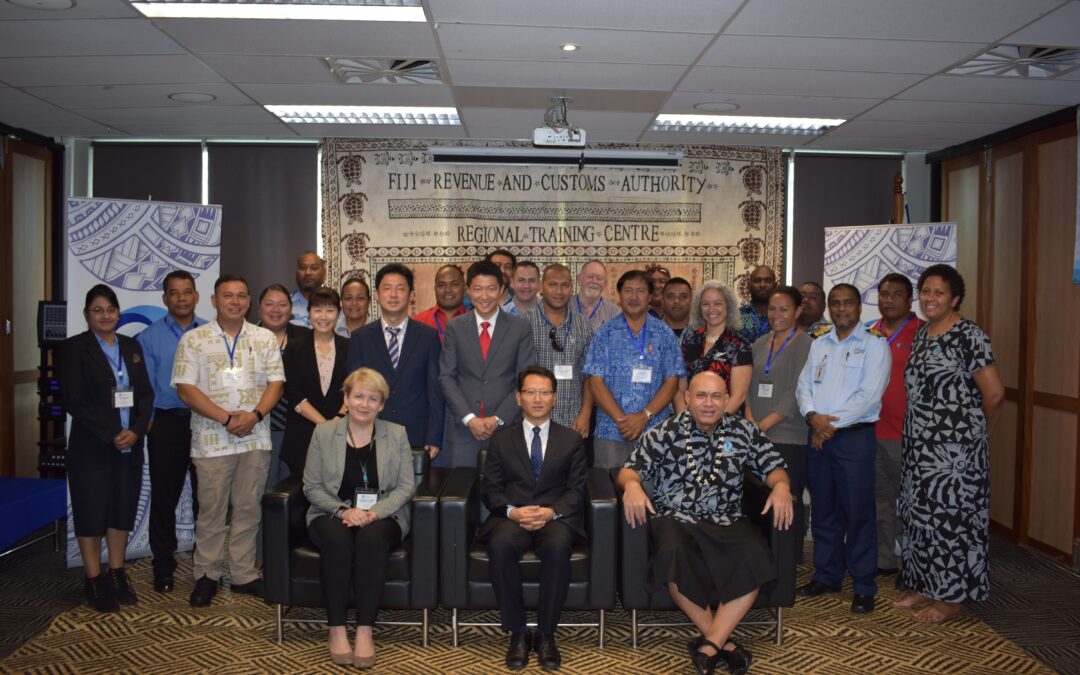
 The Regional Workshop on Customs Intelligence & Data Analysis using CENComm and other applications was held at WCO Regional Training Centre at the Fiji Revenue & Customs Services from Monday 20th November to Friday 24th November, 2017. The Workshop was organised by the Oceania Customs Organisation (OCO) Secretariat and facilitated by the World Customs Organisation (WCO) and the Regional Intelligence and Liaison Office Asia Pacific (RILO AP).
The workshop was attended by seventeen Customs officers from the following Customs Administrations; Northern Mariana Islands, Cooks Islands, Fiji, Federated State of Micronesia, Guam, Kiribati, Marshall Islands, Nauru, Niue, Palau, Papua New Guinea, Samoa, Solomon Islands, Tonga, Tuvalu and Vanuatu. The main objective of the workshop was to provide training to Intelligence Office in the proper use of the CENCOmm and other application and to develop a regional approach to Information sharing through CENComm.
 During the workshop, the WCO and RILO AP experts made a number of presentations and these included; interoperability of the WCO Customs Enforcement Network (CEN), National Customs Enforcement Network (nCEN) and CENComm applications, nCEN implementation phases, nCEN project and outline. The CEN application is an analytical tool and its functions allow users to mine data, which is crucial in terms of defining strategies, preparing risk indicators and identifying trends. The nCEN is a system developed by the WCO to assist Customs administrations with the collection and storage of law-enforcement information on the national level, with the additional capability to exchange this information at the regional and international levels. Through the adoption of the nCEN, administrations have the ability to manage information on all aspect of their law-enforcement functions, including seizures and offences and suspected persons or business entities, within a modern national system that can be standalone or used in a networked environment.
The participants were all introduced to the use of the CENcomm, the tool that will provide secure communication between customs administrations during the operational phase. At the conclusion of the Workshop, the participants committed to commence entering of seizure/detention information on CENComm. The OCO Secretariat will continuously follow up and support members in this regard.