
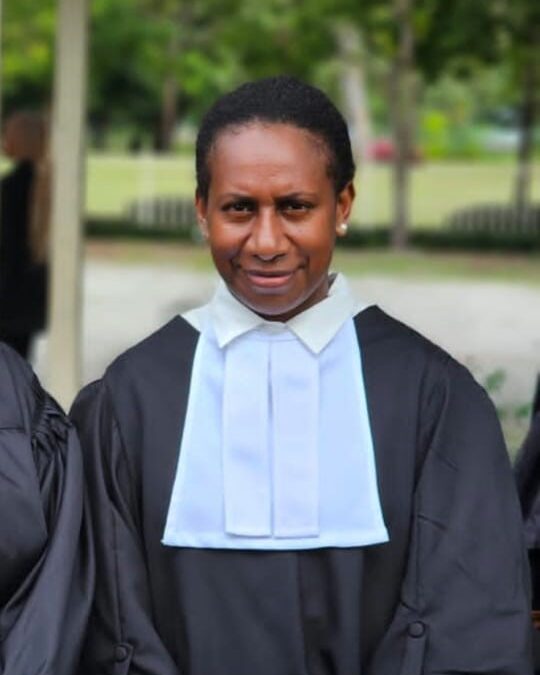
Forty years of Pacific Customs cooperation and a new generation of women leading its next chapter. The story of Jacquline Story of Papua New Guinea (PNG) Customs shows what it takes to get there.
On an April morning in 2025, Jacqueline Saleu went to work at PNG Customs Service as usual. Later that day, she slipped quietly into a line of graduates at Papua New Guinea's law school, an ordinary work outfit hidden beneath one of the blue gowns and was admitted to the National and Supreme Courts Bar. Her parents were in the crowd, they had come for her younger brother, whose science graduation was that same morning. They had no idea their only daughter was graduating too.
‘Mom and dad were shocked,’ she remembers.
Twenty years earlier, that moment would have been almost impossible to imagine. In 2005, Ms Saleu failed Grade 12. Her path to the Bar did not begin in a lecture hall, it began on the streets of Goroka, in the Eastern Highlands, selling ice blocks and betelnut.
‘I had a clear picture of where I wanted to end up, which is in the only law school in Papua New Guinea,’ she recalls.
Her ice block sales raised K500, enough to pay for upgrading English and History at the local adult matriculation school, lifting a C to a B and an A.
Studying by Orange Light
By 2008 she had her Higher School Certificate. A leap of faith into the Miss PNG Pageant brought unexpected exposure and a job as a Student Liaison Officer in Port Moresby, not the destination she had planned, but the stepping stone she needed.
‘I did not know that leap would land me in a much-needed, broad exposure that would later serve as the next stepping stone to achieving my dream, which was law school,’ she reflects.
In 2012, with workplace circumstances making formal study difficult alongside employment, she enrolled in a Diploma in Law regardless. She studied after hours, from 5pm to 3am. She never attended a lecture during working time. She sat exams in her lunch breaks. Only her roommate knew.
In her third year, with exams approaching and no leave available, she spent close to a week sleeping in the girls' ablution blocks and the car park of 3 Mile Hospital, studying under the orange car park lights. A fellow student eventually heard what was happening and convinced his parents to take her in for the remaining week.
‘Good food, a shower, security, and white lights unlike the orange hospital car park lights I had been using. Lord's blessings, indeed,’ she recalls.
Her lecturer, Mr Alfred Minei, had noticed her absence and called her in. When she explained, he listened until she had finished crying, then pointed her to affordable accommodation near campus. She tracked the accommodation manager down in a car park at 7pm to secure the room.
‘I guess my patience, or my desperation, showed,’ she says.
She graduated with her Diploma in Law. Her parents had no idea she had been studying. She had survived on K100, recycled through small loans to workmates spent on Sao biscuits, teabags and toiletries enough to pull through.
From the Intelligence Unit to the Customs Act
By 2014, PNG Customs Service had taken notice. Ms Saleu joined as an International Liaison Officer in the Intelligence Unit, later moving into the Customs Modernisation Division. Between 2021 and 2023, she completed a Bachelor of Laws while managing a full-time career and two young children, followed by full-time legal training at the Legal Training Institute in Port Moresby in 2024.
‘PNG Customs has a flexible work-study policy that gave me the career pathway to achieving a practising certificate today. I am permanently grateful for that,’ she says.
Today, as Senior Research Officer in the Modernisation Division, her work sits at the intersection of national policy and international trade law. She is at the centre of PNG's review of the Revised Kyoto Convention. the international framework that sets the standard for simplified and harmonised Customs procedures and the alignment of PNG's domestic Customs Act to meet it. She is also watching what comes next:
‘I also hope to see AI legislation and provisions to cater for this,’ she says.
A Region Changing With Her
When Jacqueline sits down to review Papua New Guinea's Customs Act, she is part of a quiet but significant shift taking place across the Pacific. Women in Customs are no longer just filling roles, they are leading agencies, shaping policy, and in some cases rewriting the very laws that govern trade and borders in their countries.
Four decades after the Pacific Customs Heads first came together, the Oceania Customs Organisation is advancing a new chapter in regional cooperation, one focused on empowering women to lead, influence decision-making, and contribute to the future of customs in the Pacific. Ms Saleu graduated from the Pacific Women’s Professional Development Programme (PWPDP) in 2022, one of the early cohorts of an initiative of the Australian Border Force delivered in partnership with the OCO and RMIT University. Initiated in 2022, PWPDP focuses on building capacity, confidence and cooperation amongst women Customs leaders across the Pacific. In a profession that is still dominated by males, 21 per cent of OCO member administrations are now headed by women.
Yet the numbers still tell a sobering story. Women make up just 36 percent of the Customs workforce globally and hold less than a quarter of management positions. It is the gap that programmes like the PWPDP and frameworks like the OCO's Gender Equality and Social Inclusion (GESI) Declaration seek to address. Signed by OCO members at the 27th Annual Conference in Guam in May 2025, the declaration commits Pacific Customs administrations to removing discrimination, building inclusive workplaces and embedding gender equality at every level of decision-making. It recognises that gender equality is not just the right thing to do, it makes Customs work better.
This year, Jacqueline was among 56 women from 16 countries who completed the PWPDP alumni programme in intelligence management, signing a joint commitment to advance women's leadership in border security. For her, what the programme changed was more fundamental than skills.
"Prior to PWPDP, I was more hesitant, more reluctant. I had points but thought I might sound stupid or incompetent. PWPDP gave me a stronger voice, increased my confidence, cancelled the self-doubts,” she adds.
Who Would Have Thought
Jacqueline is the only daughter among four children. Growing up, she says, her father's voice was constant.
“My dad always reminded me that if boys can do it, so can I. That has always been my banner. I didn't have the grades after high school, but I had one thing — self-belief."
The OCO's GESI Declaration says much the same thing in the language of institutions, acknowledging that structural, social, cultural and economic barriers adversely impact the participation of women, and that dismantling them requires commitment at every level.
At her admission to the Bar, Jacqueline turned the question she had carried since Goroka back on itself:
‘Who would have thought, a Grade 12 dropout, selling ice sticks on the streets, would one day connect with the world?’
Across the Pacific, more women in Customs are arriving at the same answer she did.
That they would.
And that they would do it together.
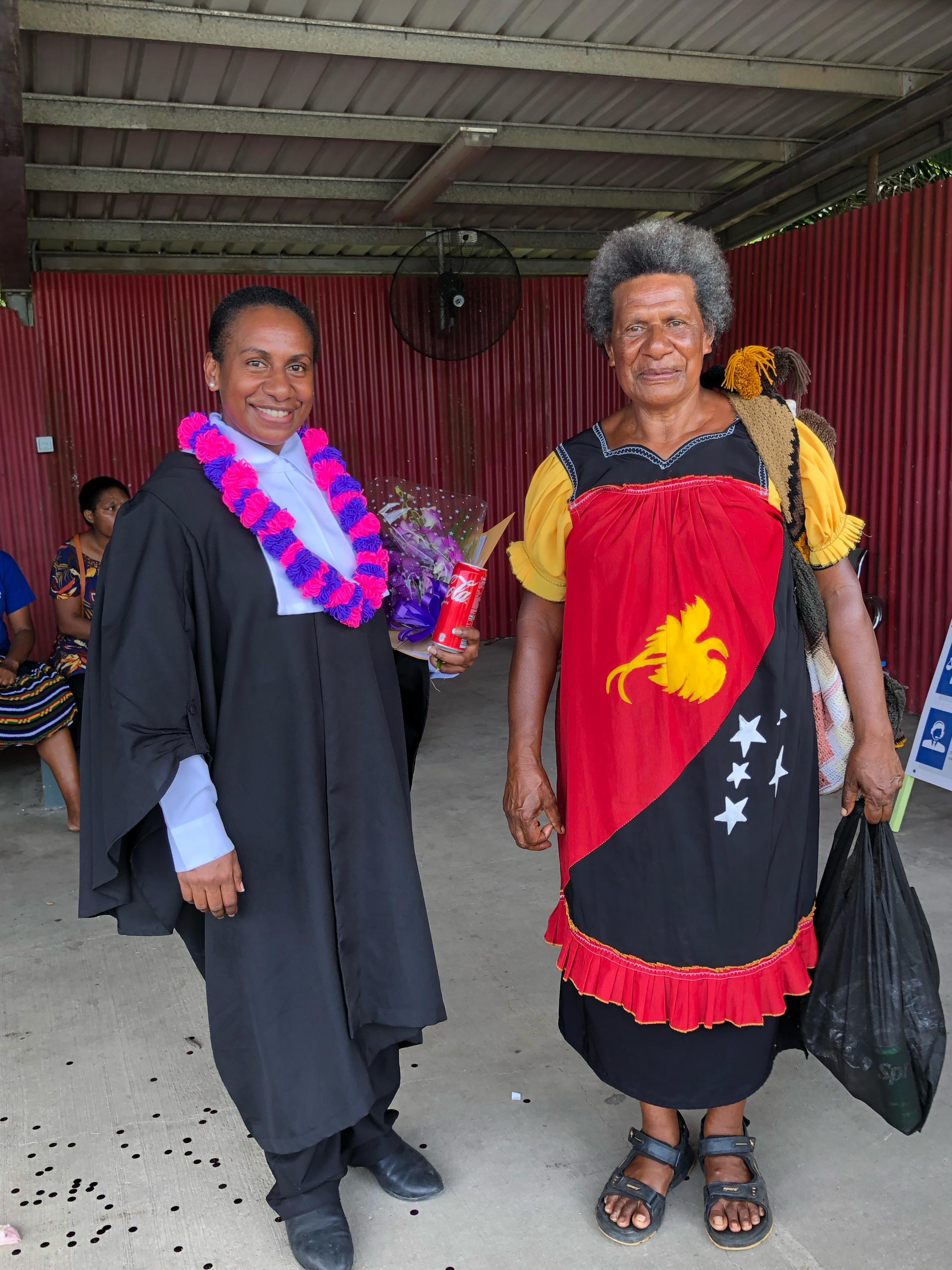
Jacqueline Saleu is Senior Research Officer in the Customs Modernisation Division of Papua New Guinea Customs Service. She participated in the Pacific Women in Pacific Development Programme (PWPDP) in 2022 and again this year, a joint initiative of the Australian Border Force (ABF), the Oceania Customs Organisation (OCO) and RMIT University. The OCO's Gender Equality and Social Inclusion Declaration was signed by OCO member states at the 27th OCO Annual Conference in Guam in May 2025.