
SUVA, Fiji- SUVA, Fiji — The Oceania Customs Organisation, representing 24 Pacific Island Customs administrations, has joined the Pacific E-commerce Alliance as global digital trade reaches unprecedented levels. The partnership, approved during OCO’s annual conference in Guam, brings crucial Customs expertise to the alliance coordinated by the Pacific Islands Forum Secretariat.
“This partnership represents a critical step forward in our collective efforts to harness the potential of digital trade for Pacific communities,” said Mr Zarak Khan, Director – Programme & Initiatives of the Pacific Islands Forum Secretariat. “OCO’s expertise in Customs modernisation will be invaluable as we work to create opportunities for Pacific businesses in the global digital marketplace.”
The alliance, established in July 2023, now comprises six partners, which are the Commonwealth Secretariat, Pacific Islands Forum Secretariat, Pacific Tourism Organisation, UN Economic and Social Commission for Asia and the Pacific, UN Trade and Development, and OCO. Global e-commerce sales are projected to reach US$6.56 trillion in 2025, with over 3 billion digital buyers worldwide (eMarketer, 2025).
“The dramatic increase in small parcel shipments through e-commerce has created detection challenges that our traditional systems weren’t designed to address,” said Mr Udit Singh, Chief Executive Officer of the Fiji Revenue and Customs Service and current OCO Steering Committee Chairperson. “We must develop tailored risk management approaches for this new commerce landscape.”
The Asia-Pacific region represents the fastest-growing e-commerce market globally, with countries like the Philippines and India showing growth rates exceeding 20% (UNCTAD, 2025). While many Pacific Customs administrations still operate with outdated systems, there has been progress. Vanuatu, for example, has developed one of the world’s most advanced electronic single window systems, achieving several global firsts including the first passenger module created in the Automated Systems for Customs Data (ASYCUDA) worldwide and the first direct online payment between a bank and Customs in the Pacific. The system reduced cargo clearance from three days to less than one day.
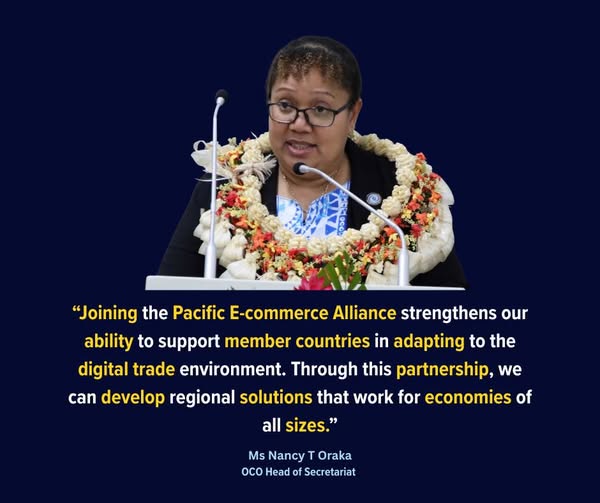
“Joining the Pacific E-commerce Alliance strengthens our ability to support member countries in adapting to the digital trade environment,” said Ms Nancy T Oraka, Head of Secretariat for the Oceania Customs Organisation. “Through this partnership, we can develop regional solutions that work for economies of all sizes.”
Eight OCO members have implemented components of a regional single window system, reducing clearing times by an average of 37%. This progress is important as global online sales are expected to reach US$7 trillion by 2027 (eMarketer, 2025). For Pacific Island nations, this growth brings both opportunities and challenges. Countries need to invest in infrastructure while gaining better access to global markets.
To capture this opportunity, the alliance operates under the Pacific E-commerce Initiative, which aims to create a “transformative Blue Pacific economy where all businesses and consumers actively engage in domestic and cross-border electronic commerce.” This work is guided by the Pacific Regional E-commerce Strategy and Roadmap, endorsed by Forum Trade Ministers in 2021, which provides a coordinated framework for strengthening digital trade across the region.
“By joining the Pacific E-commerce Alliance, we strengthen our unity of purpose and willingness to support one another,” Mr Singh said. “We understand our collective voice is stronger than our individual ones.”
For OCO, future initiatives will focus on advancing digital transformation across its membership, with emphasis on new technologies and tools adapted to Pacific contexts.
ENDS