
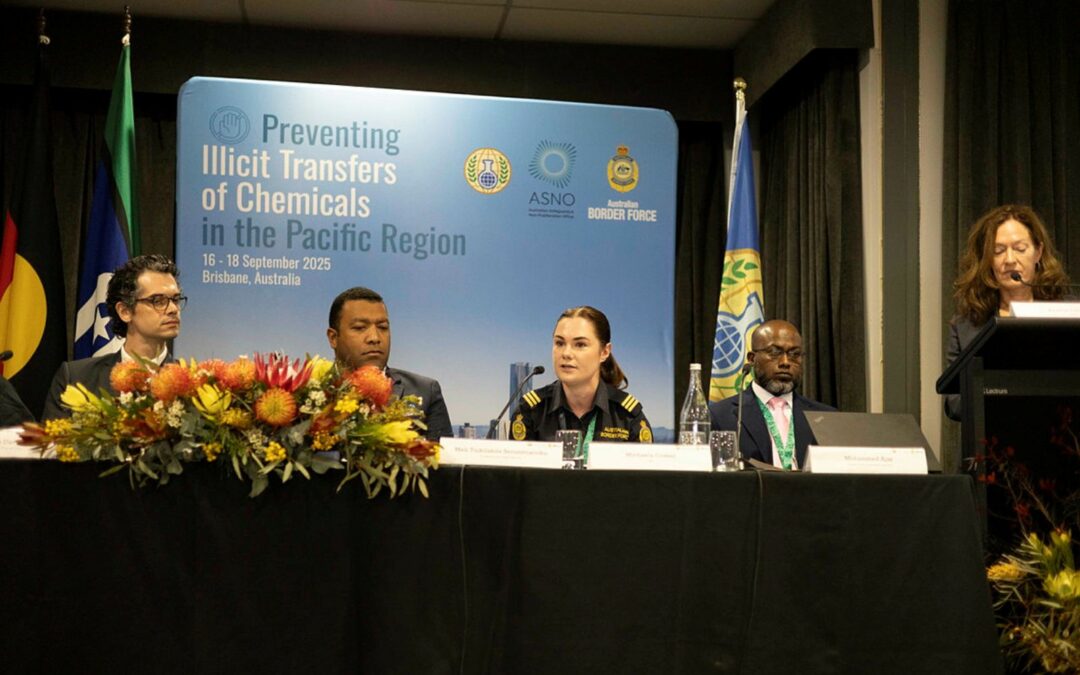
Fifteen officers from across the region learn advanced detection techniques to prevent toxic chemical smuggling
SUVA, Fiji. September 26, 2025– Customs and government officials 13 Pacific nations responsible for implementing the Chemical Weapons Convention were recently trained in Brisbane on detecting and preventing the illegal movement of toxic chemicals, as part of ongoing efforts to strengthen regional security.
The week-long program, run by the Organisation for the Prohibition of Chemical Weapons (OPCW), brought together officers from Australia, Fiji, Papua New Guinea, Solomon Islands, Tonga, Samoa, Timor-Leste, Cook Islands, Federated States of Micronesia, Marshall Islands, Palau, Tuvalu, and Vanuatu.
“Our Blue Pacific has strong commitments to peace and security, and Pacific Customs administrations are instrumental in turning those commitments into action,” said Nancy Oraka, Head of the Oceania Customs Organisation (OCO). “By sharing intelligence, building capacity together, and working alongside partners such as OPCW, World Customs Organisation, United Nations Office on Drugs and Crime, and our OCO Members, we are reinforcing a united Pacific shield against emerging threats while keeping legitimate trade moving for the benefit of our island communities.”
The training featured practical demonstrations of advanced detection equipment, including X-ray scanning systems, chemical trace detectors, and detector dogs. Officers also learned about concealment methods used in chemical smuggling, including techniques for hiding dangerous substances in refrigerated containers and other cargo.
“The ABF experts showed us how to use special technology to detect these chemicals better. Watching them use the equipment helped us understand the process,” said Tammy Luitolo from Solomon Islands Customs and Excise Division.
The Australian Border Force Container Examination Facility provided real-world scenarios that officers could take back to their home countries.
The training builds on decades of Pacific leadership in creating nuclear-free zones. The region’s 1985 Rarotonga Treaty established the South Pacific as nuclear-free, with more recent commitments under the Boe Declaration and 2050 Pacific Strategy extending that peace-focused approach.
“Pacific nations signed the Rarotonga Treaty in 1985 to create a Nuclear-Free South Pacific,” said Mohammed Ajaz, Customs Enforcement Advisor for the Oceania Customs Organisation (OCO). “Now we face a new challenge – weak enforcement of Chemical Weapons Convention standards could allow dangerous dual-use chemicals to spread throughout the region.”
The stakes extend beyond the Pacific itself – as a major maritime crossroads, stronger chemical weapons enforcement here protects both local communities and global security.
“Working together with other countries helps stop illegal toxic chemicals,” Ms Luitolo said, highlighting how collaboration strengthens individual nations’ efforts.
Officers also committed to updating their countries’ chemical profiling systems and creating joint standard operating procedures for handling dangerous substances.
Mr Ajaz said the training was part of building what he calls a “united Pacific shield” – combining intelligence sharing, capacity building, and international partnerships to stop threats while keeping legitimate trade flowing.
“Our Blue Pacific has strong commitments to peace and security, and Pacific Customs administrations are instrumental in turning those commitments into action,” he said.
“By sharing intelligence, building capacity together, and working alongside partners such as OPCW, World Customs Organisation, United Nations Office on Drugs and Crime, and our OCO Members, we are reinforcing a united Pacific shield against emerging threats while keeping legitimate trade moving for the prosperity of our island communities.”
This marks the second consecutive year OPCW has run chemical weapons training specifically for Pacific nations.
“The hands-on sessions with ABF Container Examination Facility and sharing knowledge with Asia/Pacific State Countries enhanced our ability to manage chemical incidents effectively,” Meli Serunituacoko, a customs officer from the Fiji Revenue and Customs Service said.
For smaller Pacific nations like Tuvalu, the training represents a significant opportunity to build capacity that might otherwise be difficult to access.
Falesala Imalesa Kofe, Senior Collector Preventive at Tuvalu Customs Department, said her key takeaway from the workshop was “the importance of international cooperation in preventing the misuse of chemical materials.”
“I gained hands-on exposure to practical tools and methods that I had not used before,” Mrs Kofe said. “Going forward, Tuvalu will seek assistance from OCO, OPCW and other partners in ensuring these practices are embedded into our national operations.”
She added that the training’s impact extended beyond individual participants.
“I am committed to integrating these approaches into our work and mentoring colleagues so the benefits extend not just to those attending but to others that have not attended this OPCW training,” she said.
For many participants, the training reinforced that protecting their island communities from chemical threats wasn’t just about enforcement – it’s about education, clear regulations, and working together across the vast Pacific.
ENDS