
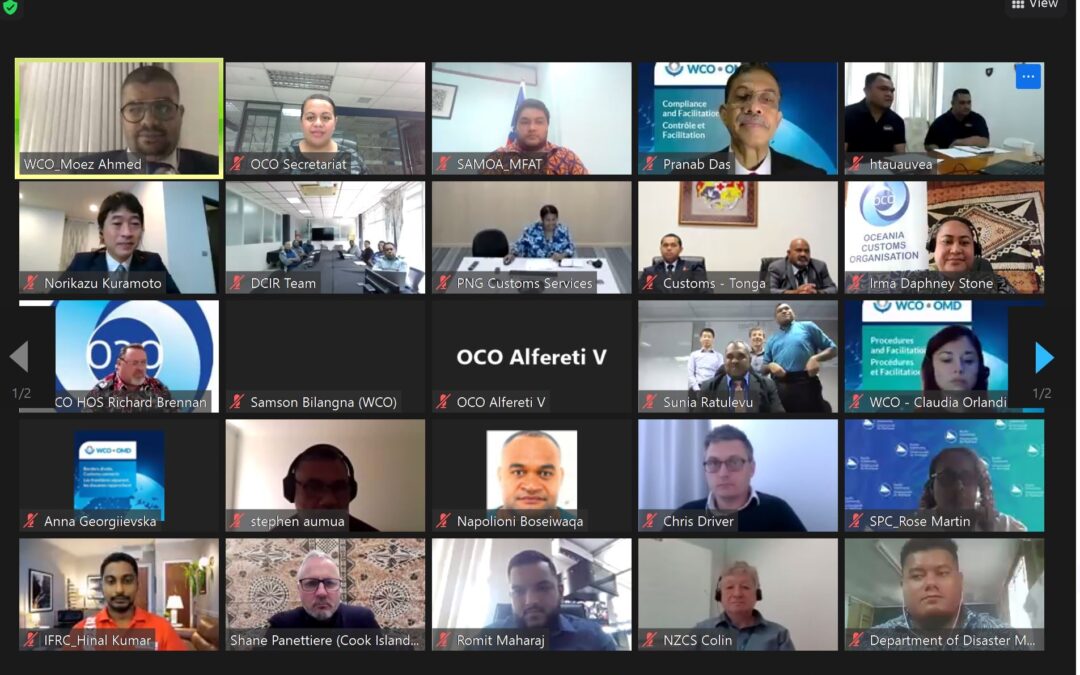
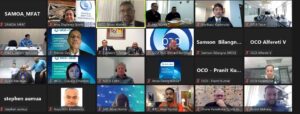
Participants at virtual Workshop
Suva, Fiji, 1 November 2021– Customs administrations and border agencies in the region shared experiences and learned best practices on how to respond better to natural disasters and infectious diseases through a four-day workshop facilitated by the World Customs Organization and the Oceania Customs Organization.
With the support of the Japanese Government, WCO held the workshop in the framework of its COVID-19 project that aims to help members, especially the least developed and developing countries to effectively respond to the impacts of COVID-19, other infectious diseases, and disruptive events to ensure the security, stability, and continuity of global supply chains, while facilitating and expediting global supply of emergency relief goods.
OCO Steering Committee Chair & Head of Cook Islands Customs, Mr. Xavier Mitchell
“Every year the Pacific region experience the recurrence of natural hazards, with high exposure to cyclones, earthquakes, tsunamis, floods, tidal surges, landslides, droughts, forest fires, and volcanic eruptions, in addition to epidemics,” OCO chairman, Xavier Mitchell said. “With a total population of 10 million people spread across a vast area, the death toll and number of victims of natural hazards may appear low in standard disaster statistics. However, the Pacific countries rank among the highest in casualties and people affected per number of inhabitants, and statistics also show that Pacific Island countries such as Papua New Guinea, Fiji Islands, Solomon Islands, Cook Islands, Tonga, and Vanuatu rank among the world’s worst affected in terms of casualties and people impacted by disasters.
“As the primary enforcement authority for regulating imports and exports, Customs administrations are key players in the global supply chain. We ensure the stability and continuity of the supply chain by facilitating and expediting the movement of relief and other critical goods during natural disasters and pandemics. The COVID-19 pandemic is a prime example of the critical role Customs play in implementing standards and measures necessary to minimise the overall impact of the pandemic on our economies and communities”, Mr. Mitchell added.
WCO Director Compliance and Faciliation Directorate, Mr. Pranab Kumar Das
The WCO COVID-19 project, Australian Border Force (ABF), Asia Pacific Economic Cooperation Forum (APEC), and the Pacific Islands Forum (PIFS) have developed guidelines on disaster management and supply chain continuity which members can follow to help them better manage any disruption in the future.
The WCO guidelines were finalized and approved by the WCO Council during its 138th Sessions and will be updated when required to reflect possible new inputs or contributions from Customs administrations and stakeholders. The APEC guidelines were developed in collaboration with New Zealand Customs as Chair of the 2021 meeting.
In the Pacific Islands, WCO through the OCO and its members is working to foster the sharing of regional experiences of the COVID-19 crisis as well as garner national support in the development and implementation of Standard Operating Procedure (SOPs) for the priority release of relief goods.
This four-day workshop has identified challenges, potential solutions, and mechanisms to facilitate cooperation in the event of a disaster including the current COVID-19 pandemic; promote the WCO instruments and tools relevant to the context of disaster relief for Customs administrations in the Pacific, and provide information on international instruments and OCO members tools and best practices for the release of relief goods.
Mr. Jayvee Santos of the United Nations Conference on Trade and Development (UNCTAD) advised the workshop of the Automated System for Relief Emergency Consignments (ASYREC), a new module to help countries using the Automated Systems for Customs Data (ASYCUDA) to lodge, clear and move disaster goods with expediency.
International Federation of the Red Cross representative Mr. Meiapo Faasau also advised the workshop on the need for nations to adopt a national register of approved donors and non-governmental organisations to limit unwanted and unsolicited goods from being dumped into a country during a disaster.
“We also hope to develop a plan for the region to move forward for closer cooperation, and some countries will also assist in the drafting of SOPs for the clearance of relief goods, which can be used as a model in other countries,” OCO Head of Secretariat, Richard Brennan said. The workshop ended on October 26.
For more information, queries, or interview requests, please email MediaOCO@ocosec.org
About OCO: OCO is a grouping of 23 customs administrations in the Pacific region. It facilitates regional cooperation, information sharing, and capacity building of its members with the overall target of supporting economic growth and improved border security in the Pacific.