
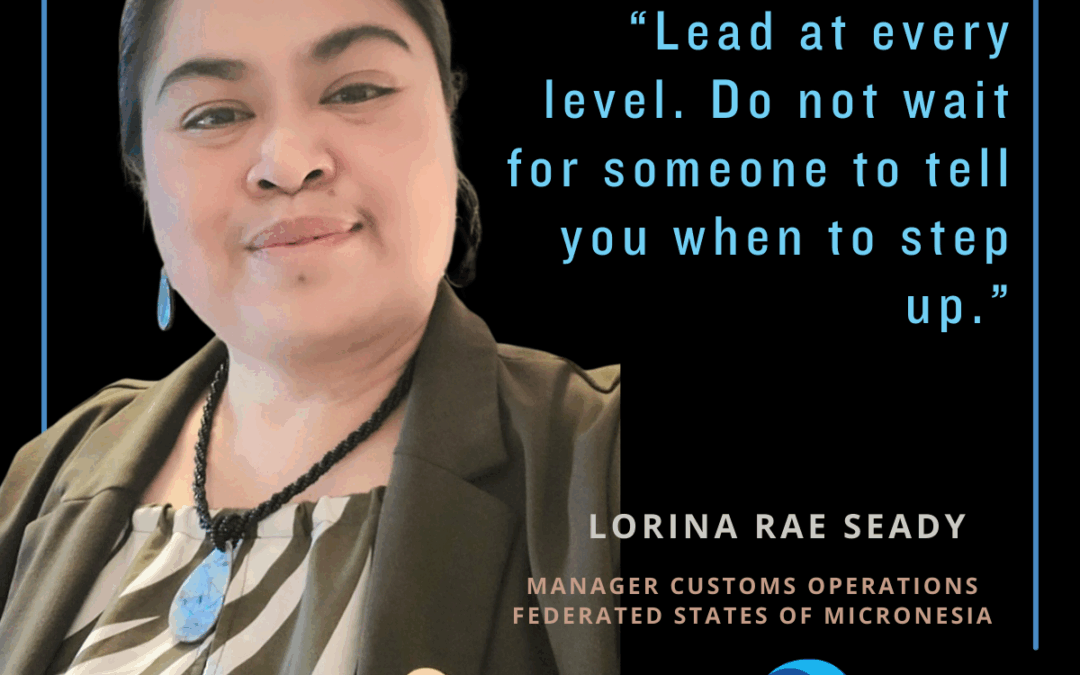
When Lorina Rae Seady speaks in meetings and nobody responds, she does not take it personally. She sends an email. Then she follows up again. It is a strategy that has taken her to the top of Customs leadership in the Federated States of Micronesia — and she thinks more Pacific women should try it.
There is a particular kind of professional invisibility that many women know well. You raise an idea in a meeting. The conversation moves on. Twenty minutes later, a colleague says something similar and the room nods.
Lorina Rae Seady has sat in enough of those rooms to recognise the pattern. As a woman who spent more than two decades working her way up through the Federated States of Micronesia’s Customs and Tax Administration, she learned early that acknowledgement rarely arrives on its own.
“When my voice is not heard, I make it a point to follow up — whether through email, messaging platforms, or in person,” she says. “I remain persistent and continue to engage until I am confident that my message has been received and understood.”
The method is practical, almost deceptively so. Behind it is something Lorina does not need to name — the quiet art of making yourself heard while remaining true to who you are and where you come from. She has spent her career navigating exactly that space. In 2022, just a few months after graduating from the first PWPDP program she attended, she was appointed Manager of Customs Operations for FSM, becoming one of the most senior women in Customs across the Micronesian sub-region. She is not inclined to overstate what it took to get there. But she is not inclined to understate it either.
‘I Use It as Motivation’
The FSM is a remote island nation in the western Pacific, spread across more than 2,500 kilometres of ocean. Its Customs administration is small by global standards but critical to an economy heavily dependent on imports. For a woman entering that world as a Customs Inspector in the early 2000s, the professional landscape was shaped as much by custom — social custom — as by the Customs Act.
“At times, I have been underestimated simply because I am a woman,” Lorina says, without bitterness. “Rather than allowing that to discourage me, I use it as motivation to demonstrate competence, professionalism, and results.”
She progressed steadily — Inspector, Analyst, Specialist — earning each step in a field that remains male-dominated across the Pacific. Her approach, she says, has been consistent throughout: stay principled, stay visible, and let the work do the arguing.
“I remain confident, stand my ground respectfully, and let my work speak for itself. By consistently delivering and upholding standards, we not only prove our own capabilities but also pave the way for other women in leadership.”
A Network Built on Islands
In 2022, Seady joined the Pacific Women in Professional Development Programme, a regional initiative run by the Oceania Customs Organisation designed to support women in Pacific Customs administrations. She speaks about it with a warmth that goes beyond professional gratitude.
Across the Pacific, where communities are separated by vast stretches of ocean, professional isolation is a genuine obstacle — particularly for women in specialist fields who may find themselves the only one in the room. The connections the programme fosters, Seady says, matter as much as the skills it teaches.
“It brings new sisters into our circle while reconnecting us with old ones,” she says. “It strengthens our bonds and deepens our knowledge as we learn from and support one another.”
In the Pacific, sisterhood is not a metaphor, it is how things get done.
‘Modernisation Is Not Only About Systems’
As Manager, Seady has inherited a reform agenda. FSM Customs is updating its systems and aligning procedures with international standards — work that involves implementing ASYCUDA, the UN’s automated Customs data management system, alongside a review of Standard Operating Procedures (SOP) that have not always kept pace with global best practice.
Her priorities are staff development, stakeholder training, and SOP alignment. Of these, the first is the most urgent.
“I am strongly focused on ensuring our officers are well-equipped to manage emerging challenges in trade and border security,” she says. “Modernisation is not only about systems. It is also about people.”
It sounds like the kind of line that gets put on strategy documents. In conversation, though, Seady’s attention to her team feels less like policy and more like instinct. She talks about the way a manager’s tone can shape the entire atmosphere of an office — and about how recognition does not need a budget line.
“Simple gestures — a small barbecue gathering to celebrate achievements, public recognition, or flexible work arrangements — can make officers feel appreciated and valued,” she says.
It is the kind of management thinking that research increasingly supports. It is also, though she would not say this herself, the kind of leadership that women are sometimes told is too soft for enforcement environments. She seems unbothered by that view.
What She Wants to See Change
Ask Seady what she would like to see differently across Pacific Customs, and her answer is direct, she wants to see more women in senior roles, and not as a token gesture.
“Women bring strategic insight, collaborative leadership styles, and resilience to enforcement roles,” she says. “Increasing women’s participation at decision-making levels will strengthen institutions and allow our administrations to fully benefit from the diverse talents women bring to the profession.”
Her advice to the younger women coming up behind her is characteristically no-nonsense.
“Lead at every level — whether you are a rookie, a junior officer, or already in a leadership role. Do not wait for someone to tell you when to step up. Take initiative, be proactive, and hold yourself accountable.”
She pauses, then adds what sounds like the lesson she has had to learn the hardest way. “Walk the talk. If you say something, follow through with action and responsibility. Leadership begins with personal discipline and integrity.”
For International Women’s Day, Seady’s message is for all.
“It is a time to celebrate and appreciate women across the globe — not only those with notable achievements, but all women,” she says. “It is an opportunity to reflect on past progress, acknowledge the challenges that remain, and commit to continued improvement for future generations.”
Then she offers the line she seems to most want women in Customs to carry with them — women who have sat in meetings and watched the conversation move on, who have typed the follow-up email and waited to see if this time someone would write back.
“Your voice matters — so use it when it needs to be heard.”
Lorina Rae Seady is Manager Customs Operations for the Federated States of Micronesia and a graduate of the OCO Pacific Women in Professional Development Programme. This feature is published as part of OCO’s International Women’s Day 2026 campaign.